2

  • Sr
0
Site logo
Sticky header logo
Site logo
0
  • Sr
  • Home
  • Products
    • Pressure Gauges
    • Thermometers
    • Valves and Diaphragm Seals
    • Pressure and Level Transmitters
    • Electromagnetic Flowmeters
    • Level Switches
    • Temperature Transmitters and Sensors
    • Digital Indicators
    • Hydraulic Hoses
    • Industrial Hoses
    • Hydraulic Fittings
  • Services
  • About us
    • Certificates
  • Laboratory
  • Blog
  • Contact

Pressure and Level Transmitters

Pressure transmitters convert gauge, vacuum, absolute or differential pressure of gases, steam and liquids into a standard 4-20 mA, 0-10 V or Modbus RTU signal for control systems, SCADA and PLCs. As an authorised distributor for leading European manufacturers of measurement and control equipment, Fadip offers pressure transmitters with ranges from 1 mbar to 1380 bar, smart transmitters with HART protocol and accuracy up to 0.075%, differential pressure transmitters and hydrostatic level probes for tanks and boreholes. Most models carry ATEX and IECEx certification for hazardous areas, and we also supply valve manifolds, diaphragm seals and digital indicators to go with them.

Catalogue: download the Fadip catalogue (PDF) with technical data on pressure and level transmitters.

Pressure and level transmitters Smart electronic differential pressure transmitter APM-2

Smart electronic differential pressure transmitter APM-2

Pressure and level transmitters Smart differential pressure transmitter PRE-28.SMART

Smart differential pressure transmitter PRE-28.SMART

Pressure and level transmitters Smart differential pressure transmitter APR-2000ALW

Smart differential pressure transmitter APR-2000ALW

Pressure and level transmitters Pressure transmitter AS

Pressure transmitter AS

Pressure and level transmitters Smart pressure transmitter APCE-2000PD

Smart pressure transmitter APCE-2000PD

Pressure and level transmitters Pressure transmitter with Modbus RTU protocol PCE-28-MODBUS

Pressure transmitter with Modbus RTU protocol PCE-28-MODBUS

Pressure and level transmitters Pressure transmitter PCE-28

Pressure transmitter PCE-28

Pressure and level transmitters Smart pressure transmitter PCE-28.Smart

Smart pressure transmitter PCE-28.Smart

Prev

Posts navigation

  • 1
  • 2
Next

SEARCH

How to choose right pressure gauge?

PRODUCTS

  • Pressure Gauges
  • Thermometers
  • Valves and Diaphragm Seals
  • Hydraulic Hoses
  • Industrial Hoses
  • Hydraulic Fittings
  • Pressure and Level Transmitters
  • Level Switches
  • Electromagnetic Flowmeters
  • Temperature Transmitters and Sensors
  • Digital Indicators

DOWNLOAD CATALOG

What is a pressure transmitter and what is it used for

A pressure transmitter is an electronic measuring device that measures pressure and sends it as a standard signal over a distance. While a pressure gauge shows the value only on site, a transmitter enables monitoring, logging and automatic process control: starting pumps, positioning valves, raising alarms and supervising the plant via SCADA. That makes the transmitter the foundation of every automated installation, from water supply and boiler houses to refineries and food production lines.

How a pressure transmitter works

The active element is a piezoresistive silicon sensor, separated from the medium by a metal diaphragm and a carefully selected fill fluid. Pressure deflects the diaphragm, the sensor's electrical resistance changes, and the electronics convert this change into a linear output signal. Smart transmitters with HART protocol allow the range, damping and diagnostics to be set remotely without removing the instrument. Differential pressure transmitters measure the difference between two pressures and are used for flow measurement across orifice plates, filter monitoring and level in closed vessels, while hydrostatic probes measure liquid level from the pressure of the liquid column above the probe.

Transmitters in the Fadip range

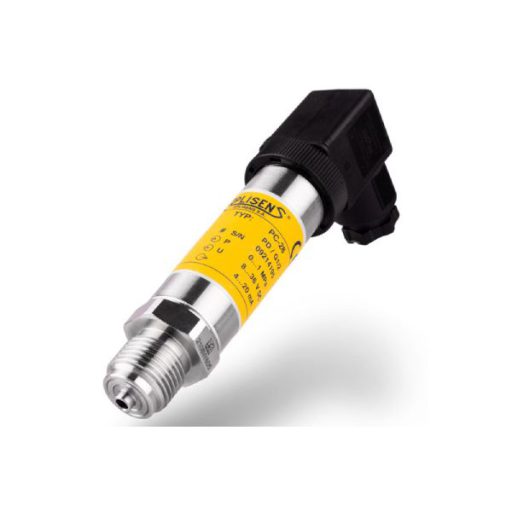
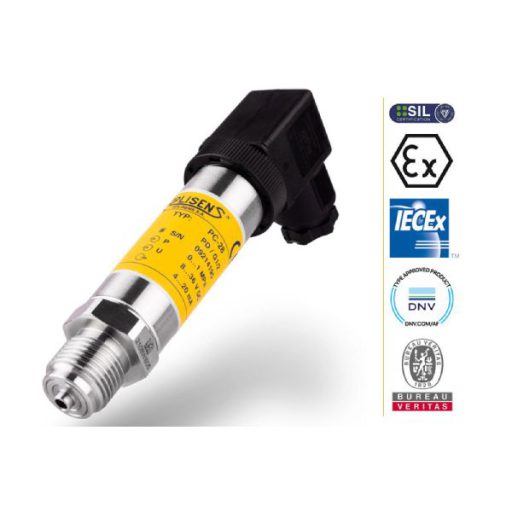
The PCE-28 pressure transmitter and AS transmitter are the industrial standard: ranges from 25 mbar to 1000 bar, 4-20 mA or 0-10 V output, 0.2% accuracy (0.16% on request), stainless steel housing and IP68 protection. For network communication there is the PCE-28 Modbus, with ranges up to 1380 bar.

Smart pressure transmitters PCE-28.Smart, APCE-2000PD with a gold-plated diaphragm and APC-2000ALW with a local display offer HART protocol and accuracy from 0.1% to 0.075% (down to 0.04% on request).

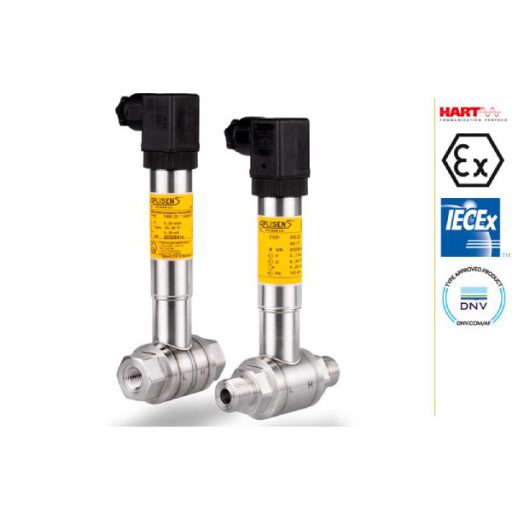
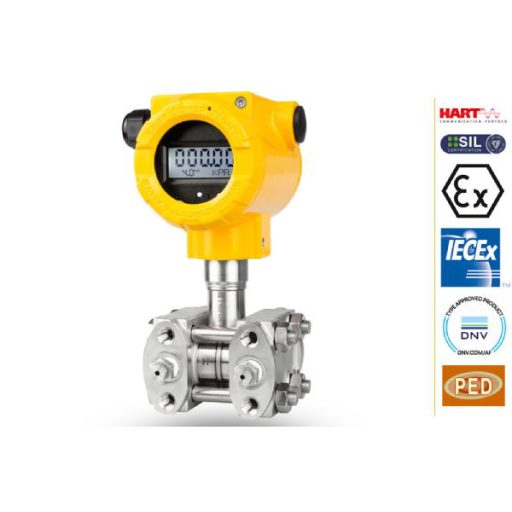
Differential pressure transmitters APR-2000ALW and PRE-28.Smart measure differential pressures from 1 mbar to 70 bar, while the APM-2 calculates differential pressure from two absolute pressure sensors.

Level probes APC-2000ALW/L, SGE-25 and SGE-16 and SGE-25.Smart measure level from 0.5 to 500 m of water column in tanks, boreholes and wastewater.

How to choose a pressure transmitter

Six parameters need to be defined. Pressure type: gauge, absolute, vacuum or differential. The measuring range should cover the working pressure with a margin for surges, and on smart transmitters the range can be turned down later. The output signal depends on the control system: 4-20 mA is the most resistant to interference and long cable runs, HART adds diagnostics, and Modbus RTU allows several devices on one line.

The medium and temperature determine the diaphragm material and whether a diaphragm seal is needed, and for viscous and sticky media a flush diaphragm is used. The process connection (G1/2", 1/2" NPT, M20x1.5, flange) must match the measuring point. For hazardous areas, ATEX or IECEx certification and the appropriate type of protection are required.

Technical specifications

The transmitters in our range cover 1 mbar to 1380 bar, with 4-20 mA, 4-20 mA + HART, 0-10 V and Modbus RTU outputs. Accuracy ranges from 0.2% on standard models to 0.075% on smart models, and 0.04% on request. Housings are 304/316 stainless steel or aluminium, with IP65 to IP68 protection. Ambient temperature is -40 to +85 °C and medium temperature up to 120 °C (150 °C for the APM-2), or higher with diaphragm seals. Process connections are 1/2" NPT, M20x1.5, G1/2", flush diaphragm G1/2" and G1", or diaphragm seal.

Pressure and level transmitter applications

In water supply and sewerage, transmitters and level probes control pumping stations, booster sets and boreholes. Power generation and district heating use smart transmitters for steam, feedwater and differential flow measurement. The chemical, petrochemical and oil industries require ATEX versions with diaphragm seals, while the food and pharmaceutical industries use transmitters with flush diaphragms and hygienic connections. In HVAC systems, differential transmitters monitor filter condition and air flow, and in hydraulics and mechanical engineering transmitters up to 1000 bar monitor presses and power units.

Why source transmitters through Fadip

Fadip is an authorised distributor of measurement and control equipment and also a pressure gauge manufacturer, so you can source the whole measuring point in one place: transmitter, valve manifold or diaphragm seal, a pressure gauge for local reading and a digital indicator. Our technical team helps with the choice of range, signal and connection, and our accredited laboratory calibrates electromechanical pressure instruments with analogue and digital display in the range from -1 to 1000 bar.

Alongside transmitters we offer valves and diaphragm seals, digital indicators, level switches and pressure gauges.

For a quotation, send us the pressure type and range, medium, temperature, output signal, process connection and hazardous area classification. Our technical team will recommend a suitable transmitter within 24 hours. Contact us.

Pressure and level transmitter FAQ

What is the difference between a pressure gauge and a pressure transmitter?

A pressure gauge shows the pressure only on site and needs no power supply. A pressure transmitter converts pressure into an electrical signal (4-20 mA, 0-10 V or Modbus) that is sent to the control system, enabling monitoring, logging and automatic process control.

What does a 4-20 mA output signal mean?

It is the standard current signal in which 4 mA corresponds to the start and 20 mA to the end of the measuring range. A current signal is immune to electrical interference and voltage drop on long cables, and a value below 4 mA indicates a broken wire or fault, which makes diagnostics easier.

What is a smart transmitter with HART protocol?

Using the HART protocol, carried on the same wires as the 4-20 mA signal, a smart transmitter allows remote adjustment of the measuring range, damping and zero, reading of diagnostics and device identification. This reduces the number of models held in stock and shortens commissioning time.

When is a differential pressure transmitter used?

A differential pressure transmitter measures the difference between two pressures. It is used for flow measurement across orifice plates, filter monitoring, level measurement in pressurised closed vessels and ventilation control. See the APR-2000ALW differential pressure transmitter.

How does a hydrostatic level probe work?

A hydrostatic probe is lowered to the bottom of a tank or borehole and measures the pressure of the liquid column above it. As pressure is proportional to the height of the column, the probe gives the level directly: 1 bar corresponds to approximately 10 m of water column. See the SGE-25 and SGE-16 level probes.

Which accuracy class should I choose?

For monitoring and pump control, 0.2% to 0.5% is sufficient. For process control, custody transfer and differential flow measurement, smart transmitters with 0.1% or 0.075% accuracy are chosen. Higher accuracy only makes sense if the rest of the measuring loop is equally accurate.

What is a flush diaphragm transmitter?

On a flush diaphragm transmitter the diaphragm is level with the connection, with no channel where the medium could collect. It is used for viscous, sticky, contaminated and crystallising media and in the food industry, where easy cleaning is essential.

Are the transmitters suitable for hazardous areas?

Most transmitters in the Fadip range carry ATEX and IECEx certification for use in potentially explosive atmospheres. When enquiring, state the zone and the gas or dust group so that we can offer the correct design and type of protection.

Can a pressure transmitter be calibrated?

Yes. The Fadip laboratory is accredited for calibrating electromechanical pressure instruments with analogue and digital display in the range from -1 to 1000 bar and issues calibration certificates to DKD-R 6-1.

Image module

Fadip – Merna Tehnika is the only Serbian manufacturer of pressure and temperature gauges, with an accredited calibration laboratory. Since 1987, we’ve been delivering reliable, high-quality measurement solutions, with custom options tailored to meet each client’s specific needs.

Links

  • Home
  • About us
  • Services
  • Certificates
  • Laboratory

Links

  • How to choose right pressure gauge?
  • Products
  • Blog
  • Contact

Contact us
  • Facebook
  • +381 (0)21 69 10 103
  • office@fadip.rs
  • Petrovoselski put br.2, 21220 Bečej
© Fadip Bečej – manometri i termometri.
div#stuning-header .dfd-stuning-header-bg-container {background-image: url(https://fadip.rs/wp-content/uploads/2025/07/fadip-bg-page.jpg);background-size: cover;background-position: top center;background-attachment: initial;background-repeat: initial;}#stuning-header div.page-title-inner {min-height: 350px;}#main-content .dfd-content-wrap {margin: -10px;} #main-content .dfd-content-wrap > article {padding: 10px;}@media only screen and (min-width: 1101px) {#layout.dfd-portfolio-loop > .row.full-width > .blog-section.no-sidebars,#layout.dfd-gallery-loop > .row.full-width > .blog-section.no-sidebars {padding: 0 20px;}#layout.dfd-portfolio-loop > .row.full-width > .blog-section.no-sidebars > #main-content > .dfd-content-wrap:first-child,#layout.dfd-gallery-loop > .row.full-width > .blog-section.no-sidebars > #main-content > .dfd-content-wrap:first-child {border-top: 20px solid transparent; border-bottom: 10px solid transparent;}#layout.dfd-portfolio-loop > .row.full-width #right-sidebar,#layout.dfd-gallery-loop > .row.full-width #right-sidebar {padding-top: 10px;padding-bottom: 10px;}#layout.dfd-portfolio-loop > .row.full-width > .blog-section.no-sidebars .sort-panel,#layout.dfd-gallery-loop > .row.full-width > .blog-section.no-sidebars .sort-panel {margin-left: -20px;margin-right: -20px;}}#layout .dfd-content-wrap.layout-side-image,#layout > .row.full-width .dfd-content-wrap.layout-side-image {margin-left: 0;margin-right: 0;}