2

  • Sr
0
Site logo
Sticky header logo
Site logo
0
  • Sr
  • Home
  • Products
    • Pressure Gauges
    • Thermometers
    • Valves and Diaphragm Seals
    • Pressure and Level Transmitters
    • Electromagnetic Flowmeters
    • Level Switches
    • Temperature Transmitters and Sensors
    • Digital Indicators
    • Hydraulic Hoses
    • Industrial Hoses
    • Hydraulic Fittings
  • Services
  • About us
    • Certificates
  • Laboratory
  • Blog
  • Contact

Pressure Gauges

Fadip of Bečej is the only pressure gauge manufacturer in Serbia. Since 1987 we have been making pressure gauges to EN 837-1, with measuring ranges from vacuum to 1000 bar and dial sizes from 40 to 250 mm, for water, air, oil, steam, gas and aggressive media. Every gauge can be supplied with a calibration certificate from our accredited laboratory, and we build non-standard ranges, dials and connections to the customer’s specification.

Pressure gauge catalogue: download the Fadip catalogue (PDF) with technical specifications, measuring ranges, dial sizes, accuracy classes and connections for every type we manufacture.

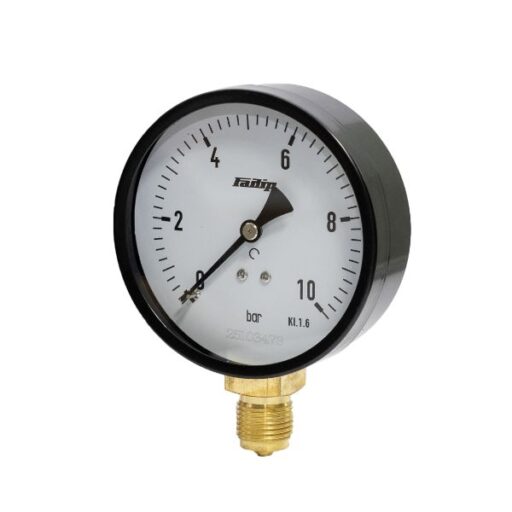
Pressure Gauge Standard Pressure Gauge

Standard Pressure Gauge

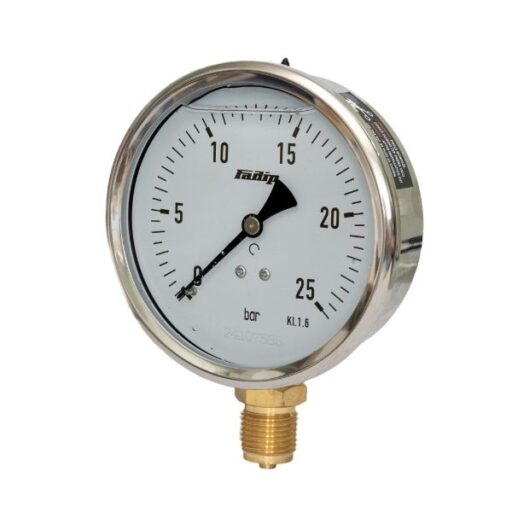
Pressure Gauge Standard pressure gauge filling with glycerine

Standard pressure gauge filling with glycerine

Pressure Gauge Pressure gauge completely stainless Type A

Pressure gauge completely stainless Type A

Pressure Gauge Pressure gauge completely stainless steel filled with glycerine Type A

Pressure gauge completely stainless steel filled with glycerine Type A

Pressure Gauge Pressure gauge completely stainless steel with bayonet closure

Pressure gauge completely stainless steel with bayonet closure

Pressure Gauge Pressure gauge completely stainless safety

Pressure gauge completely stainless safety

Pressure Gauge Capsule pressure gauge (Millibar)

Capsule pressure gauge (Millibar)

Pressure Gauge Contact pressure gauge

Contact pressure gauge

Prev

Posts navigation

  • 1
  • 2
  • 3
Next

SEARCH

How to choose right pressure gauge?

PRODUCTS

  • Pressure Gauges
  • Thermometers
  • Valves and Diaphragm Seals
  • Hydraulic Hoses
  • Industrial Hoses
  • Hydraulic Fittings
  • Pressure and Level Transmitters
  • Level Switches
  • Electromagnetic Flowmeters
  • Temperature Transmitters and Sensors
  • Digital Indicators

DOWNLOAD CATALOG

What is a pressure gauge and what is it used for

A pressure gauge is a measuring instrument that shows the pressure of a liquid or gas relative to atmospheric pressure. It is the most widely used instrument in industry: you will find one on every compressor, pump, boiler, hydraulic power unit, gas installation and pipeline, because pressure is the parameter that reveals a fault, blockage or overload fastest. Pressure gauges need no power supply, are read directly on site and, when correctly specified, run for years without servicing. That is why they remain the basis of pressure measurement despite the spread of electronic transmitters.

How a pressure gauge works

Most industrial pressure gauges use a Bourdon tube. A curved tube with an elliptical cross-section tends to straighten under pressure, and this small movement is transferred to the pointer through a segment and pinion. For low pressures up to 600 mbar a capsule (diaphragm) element is used, as it is more sensitive to small changes. The material of the measuring element determines which media the gauge can handle: brass for non-aggressive media, AISI 316L stainless steel for aggressive ones, and for the most chemically demanding media a diaphragm seal is fitted between the process and the gauge.

Types of pressure gauges in the Fadip range

Standard pressure gauges have a steel case and a brass measuring system and cover most applications on water, air, oil and neutral gases.

Glycerine filled pressure gauges dampen vibration and pressure pulsation, which makes them the first choice for pumps, compressors and hydraulics.

All stainless steel pressure gauges Type A, in dry and glycerine filled versions, are designed for the chemical, food and pharmaceutical industries and for outdoor installation. The bayonet version allows servicing on site.

Safety pattern pressure gauges with a solid baffle wall and blow-out back are mandatory on oxygen, acetylene and high pressures.

Contact pressure gauges also provide an electrical signal for alarms or pump control, while low pressure (millibar) gauges measure low pressures on gas installations, burners and ventilation.

How to choose a pressure gauge

Five parameters need to be defined. The measuring range should be chosen so that the working pressure falls between one third and two thirds of the scale. A gauge that constantly runs at the end of its scale quickly loses accuracy.

The dial size (40 to 250 mm) depends on the reading distance and the required accuracy class: class 2.5 for small dials, 1.6 for 100 and 160 mm, and 1.0 for test gauges.

The connection is usually G1/4" or G1/2", bottom or back entry, with M20x1.5 and NPT available on request. The medium and temperature determine the material and whether a siphon, diaphragm seal or glycerine filling is needed, while the operating conditions (vibration, outdoor installation, explosive atmosphere) determine the case design and ingress protection. For a detailed guide with examples, see How to choose the right pressure gauge.

Technical specifications

Fadip pressure gauges are made to EN 837-1 in dial sizes of 40, 50, 63, 80, 100, 160 and 250 mm. Measuring ranges run from vacuum (-1...0 bar), through compound scales, up to 0...1000 bar, and millibar versions cover low pressures up to 600 mbar. Dials are available in bar, MPa, kPa, psi or dual scales, with an optional red limit mark and the customer's logo. Cases are made of steel or AISI 304 stainless steel, measuring systems of brass or AISI 316L, ingress protection is up to IP65, ambient temperature -20 to +60 °C and medium temperature up to +200 °C with suitable installation. Contact versions offer magnetic, inductive and electronic contacts, including versions for ATEX zones.

Pressure gauge applications by industry

In hydraulics and pneumatics pressure gauges monitor power units, presses and air lines, while in water supply and heating they sit on booster sets, pumping stations, boilers and heat substations. In compressor stations they monitor receiver and filter pressure. Gas engineering uses millibar gauges on regulators and burners, the chemical and food industries use stainless and safety pattern versions, and agriculture and construction rely on glycerine filled gauges on sprayers, machinery and concrete pumps. Fire protection systems, medical gases and laboratories require safety pattern designs and class 1.0 instruments.

Pressure gauge calibration and servicing

A pressure gauge is a measuring instrument and its accuracy changes over time due to Bourdon tube fatigue, pressure surges or overload. Fadip operates an accredited calibration laboratory and issues calibration certificates for new and existing instruments of any make. The recommended interval is 12 months in normal use, or 6 months for instruments under pulsating loads and in safety functions. Alongside calibration we also carry out servicing: window replacement, glycerine refilling, zero adjustment and replacement of the measuring system.

Why buy from a manufacturer

As a manufacturer rather than an importer, Fadip supplies standard pressure gauges from stock and builds non-standard ranges, dials, connections and designs to specification at short notice, with no minimum import quantities. Technical support comes with direct access to production, spare parts and servicing are available for the whole life of the instrument, and calibration is done in-house.

Alongside pressure gauges we offer the complete range of accessories: valves and diaphragm seals, siphons and adapters, as well as thermometers and pressure transmitters for systems that need an electronic signal.

For a quotation, send us the working pressure, medium, temperature, dial size and connection. Our technical team will recommend a suitable pressure gauge within 24 hours. Contact us.

Pressure gauge FAQ

What is a pressure gauge and how does it work?

A pressure gauge is an instrument for measuring the pressure of liquids and gases. Industrial gauges usually work on the Bourdon tube principle: an elastic tube deforms under pressure and a movement transfers this deformation to the pointer. Fadip has been making pressure gauges to EN 837-1 since 1987 and is the only pressure gauge manufacturer in Serbia.

How do I choose the right measuring range?

The working pressure should be between 1/3 and 2/3 of the measuring range under steady load, or between 1/3 and 1/2 of the range with pulsating pressure. A gauge should not run constantly near the top of its scale, as this shortens the life of the Bourdon tube and reduces accuracy. If the working pressure is unknown, measure it first with a wider-range instrument.

What does the accuracy class (1.0 / 1.6 / 2.5) mean?

The accuracy class is the maximum permissible error expressed as a percentage of the full scale. A class 1.6 gauge with a 0 to 10 bar range may deviate by no more than ±0.16 bar. Class 1.0 is used for more precise measurement and test gauges, class 1.6 is the industrial standard for 100 and 160 mm dials, and class 2.5 is typical for smaller dials (40, 50 and 63 mm).

Which dial size should I choose?

Standard dial sizes are 40, 50, 63, 80, 100, 160 and 250 mm. Choose the size according to the reading distance and the required accuracy. A larger dial has a longer scale, finer graduation and a better accuracy class. For pipelines and machines, 63 and 100 mm are most common, while 160 mm is used for test points and panels.

When do I need a glycerine filled pressure gauge?

Glycerine filling dampens vibration and pressure pulsation, stops the pointer from fluttering, protects the movement and extends the life of the instrument. It is recommended on pumps, compressors, hydraulic power units, construction machinery and wherever pressure surges occur. See our standard glycerine filled gauges and all stainless glycerine filled gauges.

What is the difference between a standard and an all stainless steel gauge?

A standard gauge has a steel case and a brass (copper alloy) measuring system and is suitable for water, air, oil and non-aggressive media. An all stainless gauge has a case and measuring element made of AISI 304/316 stainless steel and is designed for aggressive media, the chemical and food industries, pharmaceuticals and outdoor installation in corrosive environments.

Which connection thread do I need?

The most common connections are G1/4" (for 40 to 63 mm dials) and G1/2" (for 100 to 160 mm dials), with M20x1.5 and NPT also available. The connection can be bottom (radial) or back (axial) entry, and panel mounting uses a front flange or a U-clamp. Check the thread at the existing tapping point before ordering. Fadip also supplies valves, diaphragm seals and adapters.

What is a contact pressure gauge used for?

A contact pressure gauge has one or two built-in electrical contacts that switch when the pressure reaches a set value. It is used for signalling, alarms or automatically starting and stopping pumps and compressors. See our contact pressure gauges.

When is a safety pattern pressure gauge used?

A safety pattern gauge (EN 837-1 S3) has a solid baffle wall between the measuring system and the dial, a blow-out back and laminated safety glass. If the Bourdon tube ruptures, the medium is vented backwards rather than towards the operator. It is mandatory for oxygen, acetylene and high pressures, and wherever regulations require operator protection. See our safety pattern pressure gauges.

What is a millibar (low pressure) gauge?

A millibar gauge measures very low pressures, typically from 0...2.5 mbar to 0...600 mbar, and uses a capsule (diaphragm) element instead of a Bourdon tube. It is used on gas installations, burners, ventilation, filters and air conditioning. See our low pressure gauges.

Can the same gauge measure vacuum?

Yes. A compound gauge has a scale covering both negative and positive pressure (for example -1...+5 bar), while a vacuum gauge measures only negative pressure (-1...0 bar). Fadip makes both types in standard and stainless versions.

How often should a pressure gauge be calibrated?

The recommended interval is 12 months for instruments in normal industrial use, and more often (every 6 months) for pulsating loads, aggressive media and instruments with a safety function or under statutory control. Fadip has an accredited calibration laboratory and issues calibration certificates for new and existing instruments.

How should a pressure gauge be installed?

Tighten the gauge using a spanner on the hexagon of the connection, never by turning the case. Fit a siphon for steam and hot media, a snubber or glycerine filling for pulsation, and a diaphragm seal for aggressive media. The instrument should be mounted vertically unless stated otherwise and protected from vibration and ambient temperatures outside -20 to +60 °C.

What are the most common mistakes when choosing a pressure gauge?

The most common mistakes are a range that is too narrow or too wide, a brass measuring system on an aggressive medium, a dry standard gauge on pumps with pressure surges, the wrong thread and ignoring the medium temperature. If in doubt, send us the working pressure, medium, temperature and installation point and our technical team will recommend a suitable model.

Does Fadip make pressure gauges to customer specification?

Yes. As a manufacturer we build gauges with non-standard ranges, dual scales (bar/psi, bar/MPa), the customer's logo on the dial, special connections and versions for ATEX zones or oxygen service (oil and grease free). Lead times and minimum quantities depend on the design.

Image module

Fadip – Merna Tehnika is the only Serbian manufacturer of pressure and temperature gauges, with an accredited calibration laboratory. Since 1987, we’ve been delivering reliable, high-quality measurement solutions, with custom options tailored to meet each client’s specific needs.

Links

  • Home
  • About us
  • Services
  • Certificates
  • Laboratory

Links

  • How to choose right pressure gauge?
  • Products
  • Blog
  • Contact

Contact us
  • Facebook
  • +381 (0)21 69 10 103
  • office@fadip.rs
  • Petrovoselski put br.2, 21220 Bečej
© Fadip Bečej – manometri i termometri.
div#stuning-header .dfd-stuning-header-bg-container {background-image: url(https://fadip.rs/wp-content/uploads/2025/07/fadip-bg-page.jpg);background-size: cover;background-position: top center;background-attachment: initial;background-repeat: initial;}#stuning-header div.page-title-inner {min-height: 350px;}#main-content .dfd-content-wrap {margin: -10px;} #main-content .dfd-content-wrap > article {padding: 10px;}@media only screen and (min-width: 1101px) {#layout.dfd-portfolio-loop > .row.full-width > .blog-section.no-sidebars,#layout.dfd-gallery-loop > .row.full-width > .blog-section.no-sidebars {padding: 0 20px;}#layout.dfd-portfolio-loop > .row.full-width > .blog-section.no-sidebars > #main-content > .dfd-content-wrap:first-child,#layout.dfd-gallery-loop > .row.full-width > .blog-section.no-sidebars > #main-content > .dfd-content-wrap:first-child {border-top: 20px solid transparent; border-bottom: 10px solid transparent;}#layout.dfd-portfolio-loop > .row.full-width #right-sidebar,#layout.dfd-gallery-loop > .row.full-width #right-sidebar {padding-top: 10px;padding-bottom: 10px;}#layout.dfd-portfolio-loop > .row.full-width > .blog-section.no-sidebars .sort-panel,#layout.dfd-gallery-loop > .row.full-width > .blog-section.no-sidebars .sort-panel {margin-left: -20px;margin-right: -20px;}}#layout .dfd-content-wrap.layout-side-image,#layout > .row.full-width .dfd-content-wrap.layout-side-image {margin-left: 0;margin-right: 0;}